


Yellowstone National Park
Yellowstone is so different from other national parks, in a variety of ways. First, it’s the original US National Park, established March 1, 1872 by President Ulysses S. Grant. It’s also the second largest national park in the contiguous 48 states - only Death Valley and a handful of Alaskan national parks are larger. Last, at least from the perspective of parks we’ve visited, the area has been and still is very geothermally active as a result of the supervolcano underneath it. The last major volcanic eruption was about 631,000 years ago, which made the center of what is now the park collapse into the Yellowstone Caldera, which is approximately 30 miles by 45 miles. The ongoing activity in the region has created some interesting hydrothermal features, with new ones occurring regularly - the most recent localized eruptions occurred in June this year (luckily, after we left!), throwing rocks into the air and creating new vents in the ground that were filled with boiling water. Hard to imagine what it was like for tourists visiting that day.

As I mentioned, this park is really big - approximately 2.2 million acres. It’s located primarily in Wyoming, with slivers in Montana and Idaho. Visiting requires prepping a strategy in advance for making the most of limited time in the park and navigating around the crowds. There’s also very limited internet connectivity throughout the park (our hotel didn’t even have wifi), another good reason to pre-plan. There’s a big looping road in the middle of the park with spokes that mostly take you out of the park in different directions. But, you have to know in advance which of the roads are open, since most are closed for the “winter” (which lasts October through May!!). They do have a handy dandy map that is color coded so you know when each of the roads will open each year - see the image. The window of opportunity to visit is not big, and the weather there is very unpredictable - there was a significant snowstorm the day before we arrived on June 11! Luckily, it was sunny and comfortable while we were there.
The park as a whole is beautiful, but the biggest draw for us was all the wildlife that just hang out with you everywhere you go. Some of the areas are bigger draws for the animals because of the weather and/or vegetation, so you can generally expect to see them there, and some of the encounters are much more random (for example, why is the bison walking by the very hot spring? The ground is smoking!?!?).
Here is what we saw:

Black Bears: The only photo I managed was this poor one from far away. Yeah, he’s the black smudge in the middle. But we also got to see a mommy with a cub by the side of the road later in the trip. A ranger was directing traffic and not letting anyone stop, to protect the mom and baby (and the stupid tourists harassing the bears, of course 😁).
Grizzly Bear: We were not able to get a photo of this one either, but a BIG guy was sauntering along a hillside just above a busy road (less than 10 feet up). The road was full of people trying to get closer/get good photos, including people with very small children. At that point, I think the kids were in more danger from their parents not watching them in the middle of the road than from the grizzly.
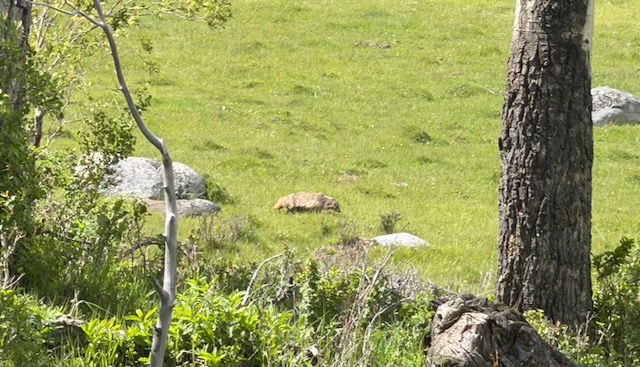
Badger: We could not believe we saw this one as we drove by. It was an awesome rare find. Not sure how I noticed it from the road.
Bison, bison, everywhere: We were warned that it might get old, but honestly, it didn’t for us. Our favorite bison was Ernie, our house bison - we named him because he hung out a lot outside our hotel window. We also noticed that there seemed to be a bunch of introvert bison - we would see a large grouping/herd of them and then one far off by him/herself. Bison also seemed completely comfortable hanging out with other animals, like elk, which we found odd for some reason.
Bison Ernie in front of our hotel. Ernie from our window. I kept appropriate distance from Ernie, but he was just right there. Ernie must also like the view of Lake Yellowstone. Bison near the hot springs. Check out the baby! One of the herds we saw in Lamar Valley. Not fussed by us! I took this photo from faaar away. He did not look friendly. Yeah, they have their backs to each other. Different kinds of animals just chilling together.
We saw many more, but didn’t manage to get photos of all of them. I guess we were more focussed on enjoying - Pronghorn (which are not deer, but we learned are more closely related to giraffe), mule deer, osprey, duck, eagle, elk, etc.
Elk hanging out, unbothered by us. Check out the rack on this guy! Pronghorn Sleeping ducky.
Our second favorite part was the large number of dramatic waterfalls that we found all over the park. We went to some of them on purpose, and serendipitously found some amazing ones just off the main roads as we took a long looping road trip around the park on our last full day. Below are shots of most of the ones we saw - see many more in the Yellowstone gallery.
Lower Falls from the North Rim - Grand Canyon of the Yellowstone. Lower Falls from the top of the Red Rock Point Trail Upper Falls in Grand Canyon of the Yellowstone. Gibbon Falls Tower Fall
Grand Canyon of the Yellowstone: While not as exciting as THE Grand Canyon or Canyonlands, Grand Canyon of the Yellowstone was very pretty and the waterfalls were great (see upper and lower falls above)!
Old Faithful:
I put this one at the bottom of the post, since it’s something already familiar to everyone (see our video at the top of the page). Geysers like Old Faithful erupt “regularly” because, in between eruptions, water refills the basin below the geyser, heat turns the water to steam, which increases the pressure, until the pressure is high enough for the next eruption. It’s all physics, so can be reliably predicted within certain margins of error based on the size/configuration of each geyser. Every day, rangers evaluate each geyser after each eruption and then post the next expected times. See current predictions here.
When we arrived in the park, we went to the Old Faithful area first because it was mid-afternoon and that was when there was supposed to be the least tourist traffic (not none, just less 😁). I had read that there was a great hike up to an overlook where you could watch the eruption, so we did that as soon as we arrived to ensure we saw at least one eruption (see the video at the top of this page).
Side view of Geyser Hill, one of the most hydrothermally active areas in the park. View of Old Faithful from the overlook. See all the people around it? Eruption starting! Photo from about half way through, it got about 25% higher this time.
After that, we wandered around enjoying more of the hydrothermal features - you can see more about those in the gallery.
One other note for anyone planning to visit Yellowstone - there are not a lot of what I would consider convenient places to stay outside of the park. That’s mostly because the park is so big, sometimes the lines to get into the park are LONG and you have to hope the roads you want to travel are clear of snow and wildlife (you can get stuck for an hour when a bison decides to meander on the road). For efficiency, we decided to stay in one of the hotels in the park and in hindsight that worked out really well for us. NOTE - the rooms fill up WAY early. When we made our reservation three months in advance, there were only two rooms left at the Lake Yellowston Hotel. In case you are curious, we liked our hotel - the rooms were small because of the age of the hotel, but very nice. I would caution everyone that the food was not great at the hotels in the park (not terrible, I think I just expected more based on the marketing). It’s not worth paying for the “fancy” dinners unless you are excited about the views from some of those dining rooms.


Comments